Saturday, March 19, 2011

Shosholoza Meyl*


Not to be outdone by my "Light Industry of Zambia" tourism, TJ decided we should take his parents actually some place nice and beautiful and warm and fun.  As anyone who has spent time in/around Lusaka will know, there is NOT A WHOLE HECK OF A LOT TO DO and anything fun is either a giant hassle or so expensive that you do it once and never again.  Really.  It's a very family-and-friends oriented lifestyle here if you are not a big drinker (-- even if you are!) There are plenty of excuses for sundowners in Lusaka.  Being barely able to finish a bottle of Mosi Lager myself, I take advantage of any open door I see.  Want to go to the foam matress factory?  Sure!  The football stitching workshop?  The gemstone studio?  Want to come on a photoshoot in the compound? Order furniture from the roadside Kalingalinga carpenters? Why not!  I outdid myself with the tannery tour, sheesh.

TJ decided to add a layer of drama to his fancy-pants tourism itinerary:  Cape Town....BY TRAIN.  And we'll do the trip by the skin our teeth:  starting with barely making the plane to Johanesburg.  There are two morning flights to Johannesburg on South African Airlines and on Zambezi Airlines.  They leave about 20 minutes apart.  Par for the course are unnecessarily long lines, ridiculous charges (our $49 one way tickets ended up about $300 apiece for the roundrip with taxex but not including the departure tax which is an additional $30 a ticket, to be paid in cash at the airport.)  The airport, however seem totally caught off-guard every day by the number of people who show up every day for these daily flights:  They never have enough people working and there is always a pen-shortage and a stamp-pad ink shortage.   This morning's rush was further hampered by missing 'exit' forms required for all international flights.

Now they have some hi-tech iris scanner contraption and finger print scanner, too, which only complicates things and distracts everyone. I'm sure Interpol requires it to keep the airport certified for international flights.  How things are run here in actuality can be summed up by the fact that the last thing you do before you can go to the boarding area (more like a holding cell) is to get your name and boarding pass recorded into a giant ledger by a guy in a metal folding chair siting at a card table at the bottom of sometimes-functioning escalator. And he may need to borrow your pen, by the way.

Usually you just walk out to your plane but on this morning we all crammed into a shuttle bus.  We did a tour of the entire airport and ended up nearly back where we started, but about 20 meters past where we got on the bus.

Once in Jo'burg we learned that the slick new Gauteng trains don't actually go to the train station just yet.  They did a big rush to finish them in time for World Cup but the train only goes to Sandton City -- the posh supermall of Africa.  So, we took a taxi/van to the station instead.  Finn "Safety-First" Jennings cracked our driver up by finding and untangling seatbelts for everyone that clearly have never been used.  (never mind that Finn and I ended up sharing a seatbelt and were literally buried under a mountain of our unsecured luggage.

We expected trouble at the train and found it.  We had incredible difficulty with the booking and had the booking cancelled the week before we left despite paying for two sleeper cars.  So, upon arrival, it was no surprise that while we had the booking we had to pay for the tickets, again.  I was the reluctant train passenger and TJ had something to prove, so we were both on a mission.

I will just say now that the train was AWESOME!  It was cheap, easy (ahem), comfortable and really fun despite the hassle (with which I'm only just getting started!)  I have never ridden a train except for short distance commuter trips in big 1st world cities.  A 24-hour train trip from Jo-berg to Cape Town was never on my list of things to do.  We all would do it again.  (But I'm not doing the 48-72+hour trip to Tanzania.  Ever.)


To make this long story even longer, we must have signed up for the BONUS tour b/c instead of a 24 hour train ride, we actually got a 28 hour train trip, a 7 hour stopever, a mid-journey hiking tour of the actual tracks, and a 5 hour bus ride**.  Also, I got to shower with an ostrich.

Above: Getting off the train 10 hours from Cape Town.  derailment?  power failure?  slow strike? Below, Bev, putting on a brave face and getting mentally ready to the trek to the waiting buses


*Shosholoza Meyl is the name of the train company.  They promise their customers a "Pleasant Experience" from when they book and pay for their tickets to when they disembark at their end destination.....
**Again, Finn "Safety First" Jennings spent much time crawling around under the seats to recover seatbelts.  The South African ladies sitting near us where in hysterics, so he found their seatbelts, too, they were ever so grateful.

Impala

Alive and Kicking, the Prequel


A while back I did a photo-essay about the making of a football after touring the workshop for "Alive and Kicking,"  a UK-based non-profit which makes and sells fair-trade, hand-stitched leather foot/soccer balls. 

We had the opportunity to visit the workshop again but the 'tour' this time started not with the cutting of the leather into 32 pieces, but with a hide straight from the cow.  Here are highlights from the ZamLeather tannery tour.

Zambia has "Zam" everything.....ZamShu, ZamBeef, ZamLoaf, Zam-Zam-ShaaaZAAAMMMM. So, naturally, ZamCows provide the tannery with ZamLeather and ZamLeather provides the basic materials for the Alive and Kicking socccer balls.  They have a unique arrangement where the stitching workshop in on-site -- ZamBeef and ZamLeather provide the leather and the workspace.  They also generously buy footballs which they in turn donate within Zambia.  Time for a group hug.


The process starts with the hide straight from the slaughterhouse. (Disclaimer:  There may be some serious gaps in my information, I was more concerned with the photos than the details of the process!) The hides first get cleaned -- they are put into these gigantic tumblers with water, lime and salts.  Now I know that White Hydrated Lime is used for:  sugar refining, water treatment, road construction, sterilization, metallurgical processes, coal processing, sewage treatment, bleach manufacture, whitewashing and....leather tanning.

When the hides have tumbled around with the salts for 72 hours or so, they come out blue!  At this stage they are rough and thick and pretty stiff.


The hides get put through the wringer....literally.  They are pressed one by one through two giant rollers and taken directly to a scanner table which digitally calculates their size.


80% (roughly) are immediately rolled up, marked and packed for export to the US, South Africa, India, etc.


The remaining 20% stay on-site (and in Zambia) for further processing.  The first/next step is splitting the leather into two.  Into the splitter it goes:

 And out:

The top pieces are numbered with chalk (#8 below) and stacked 200 hides-high.  These are uniform thickness and higher quality.  The bottom pieces are the leftover and they are used as well for processes that don't demand/require the best leather.

 The split hides go on to the next room for rough cutting, conditioning and dying.  There is not a big demand for baby-blue leather apparently.

 I liked the look of these hanging hooks

Below, excess leather at the edges are hand-trimmed to make processing easier.

Below, the dying and processing shed.

The pieces from which the footballs are made are actually 4 layers:  a synthetic coating, the leather, a latex layer (for bounce) and a cloth layer.  The layers are run through machines like this one -- a combination press and iron.  Below, they are demonstrating how the two pieces (synthetic coating and leather) are fused.  Once again, in it goes:


and out!
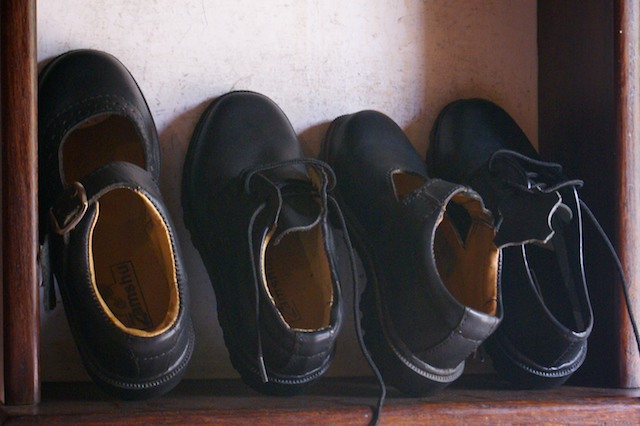
The process is repeated with the materials for each layer (depending on it's final use it may not get all the layers).   ZamShu, the standard-issue school uniform shoe (below) and the boots made for the military, for example. 


From here is goes on to Alive and Kicking.


Each stack of 32 pieces are stitched together to make one football.

Jewels of Africa

It's no secret that natural resources prop up many economies in Africa.  Zambia's economic successes and failures are closely tied to the price of copper, which makes up 86% of the GDP.  And while diamond mining supplements many Southern African incomes, Zambia is not (yet?) a signatory to the Kimberly Process Certification Scheme (KPCS).  Zambia IS able to mine and trade in other gemstones, most notably emeralds, tourmalines, citrines, garnets, etc.

I recently hooked up with a family-run company which works a 'mine to market' scheme -- meaning they do everything with no middle-men.    The level of transparency in their operation is such that they routinely open their doors to anyone who asks.  And so, we asked. And this is what we saw.


In a building behind the tennis courts and swimming pool of one of Lusaka's 4-Star hotels is the unassuming workshop for "The Jewel of Africa," a family-run company which owns some small mines and has established themselves as one of a handful of Zambia's gemstone and jewelry.  The operation is totally self-contained, the workshop does everything from the metal smithing and gemstone cutting to designing, marketing, and retailing. The above photo is from the 'homewares' workshop where they make silver trinkets like souvenir teaspoons, napkin rings and such.  


Each worker has a set of projects and keeps their tools and 'in-progress' items in their own little lock-box.


In another room, they are working on silever and gold jewelry, making necklaces, bracelets, and setting stones (above, a butterfly necklace in progress.  below, citrines waiting to be set)  They learn their craft through apprenticeships, training, and hands-on-experimentation.


Above, this jeweler is polishing the loops on silver charms.  The charms depict Nyaminyami, the River God of the Zambezi who has the body of a snake and the head of a fish.  The people of the river valley in Zambia and Zimbabwe believe they are protected by this ancestral spirit, who "fed them from his own meat in times of hunger." Given that most tourists leave zambia with a Nyaminyami carving, charm, walking stick or necklace of some sort or another, I'd say this story is incredibly relevant today.


The jewelry is entirely hand-made


This is the casting room where two artists sit, one making silver necklaces, the other making cast figurines of animals.  This gentleman (below) is the necklace maker, and I think that 'gentleman' is the most fitting term to describe him.  He is lovely and patient and exceedingly talented. The question we all asked was, is anyone apprenticing with him?  Has he found someone willing to take a spot at the bench next to him? (Ooop, after the question about his eyesight and working with such tiny tiny tools and tiny tiny links.) He starts with a spool of silver thread, winds it into a spring, cuts each loop of the spring and connects the loops to form the necklaces.  This description does not do justice to the necklaces he makes, of course.  Some are simple chains but most are intricately braided creations.


It was really neat to see the figurine casting.  In my end-of-the-rainy-season-allergy-fog I'm not remembering the details but know they use the 'Indirect, Lost Wax Process' involving wax models, rubber molds, and slurries to do models making (positive and negative), chasing spruing, polishing..


The gemstone cutting starts with raw stones (cutting the facets by hand) and ends with creating the settings and finishing the pieces.  They just finished a gorgeous video which shows the details of the entire process -- (I'll link it up as soon as it's posted!) Below is Todd's Dad admiring their cut emeralds.


and Finn, who walked away not with the $10,000 emerald and diamond pendant but with a pretty pink and green tourmaline rough...


Seeing Spots


It's a sign


We just returned from a fabu holiday in Cape Town, South Africa.  (Above, the sign at the lighthouse which was decomissioned soon after it was installed b/c it was too high and usually too fogged in to be useful.) There was something incredibly amusing about the Afrikaans language and we found a lot of signs that tickled our funny bones.  Besides all the unfamiliar place names (we stayed at a B&B off Katzenellenbogeng Weg in Nordhoek, for example.) the signs always had us laughing.  Here are a few:

 On the train

At the beaches (gorgeous, white-sand...), they fly different color flags depending on shark sightings. The area is famous for both surfing AND sharks, go figure.  Green means GO - spotting conditions are good and there are no shark sightings.  Black means that spotting conditions are poor.  Red means there are sharks in the area. White (accompanied by a deafening siren) means GET OUT OF THE WATER.  We opted for surfing with the black flag flying.


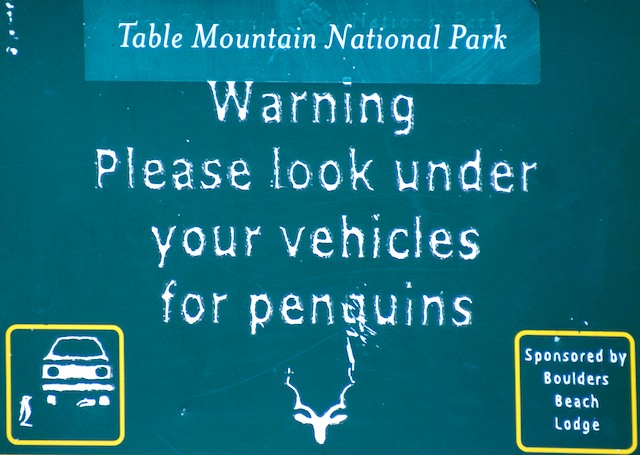
Finn took the position of penguin-checker for the week.  In Simon's Town the penguins have a few beaches which are protected during the breeding/nesting/molting season but most areas are open for people and penguins.  The people respect the 'stay on this side of the barrier' rules but the penguins are not, they are waddling around all over town.  The kids got their shoes pecked unexpectedly more than a few times.


The polite words for essential bodily functions are "poo" and "wee" but it still makes us giggle. (He said "POO!!!")


There is a sign at the Cape of Good Hope (the south-western most point of the continent -- NOT the most southern point) with English and Afrikaans.  There is a small parking lot at the beach here where the tour buses full of drunk people of all nationalities (but, we observed, one nationality per bus) doing the Cape Town tour (enjoying the amazing South African wines, hence the tipsiness) come to take photos.  They come in, wait politely in queues and have their photo taken at the sign and get back on the bus).  We opted to stay a while and do some hiking but it was funny to see all the buses of people come all that way for a 5 minute stop and a quick photo.   Been there, done that.  But we still can't say Kaap Die Goeie Hoop with a straight face.  (I think it reminds us of one of the kids' favorite books, "Martha Speaks" about a dog who eats alphabet soup)


This last sign is actually from Zambia -- it's from our smallest national park and is of course a list of what NOT to do, but it reads like a list of suggested activities: