Thursday, August 22, 2013

To market, to market

The boys with Sawanee inspecting some special fruit.  these pears were and melons were imported and not for man-handling. Most of the produce and goods in this market were local or at least from within Thailand.
t didn't occur to us until after we got home that for many tourists, esp. western tourists the idea of going to the local market would be a big deal.  But coming from Z where market day is a regular (and often annoying!) errand, we had a bit different perspective.

That said, there are plenty of nuances to appreciate -- and LOTS of snacks.  Snacks are a novel concept. Street food is not common here -- and if it's offered, you had better trust your source.  (There are a few fritter/donut stands I have been known to frequent in Mondevu (yes I have eaten food there if it's cooked in front of me).

We passed on a few things like the fresh-frog parts, blood tofu bucket-o-eels but were honestly tempted by the 'birds in baskets' which you purchase in order to set free.  This is something people do in Zambia where the 'caged bird' trade is a roadside phenomenon.  In Thailand it's part of a spiritual ritual, in Z it's more of a social/ethical/environmental statement.

Let's carry on with the market tour:

Not your normal glazed donut.  While a regular ole fried dough is called Pa Thong Ko, these golden beauties are just slightly sweet with green onions (to balance the sweetness).  The surprise is that hiding inside a sweet-bean-curd.  You know your baker/fryer has done them properly if when you shake the fritter, it feels like there is a marble inside.
This smiley guy has the job of forming the curd ball and then wrapping it in dough.


Motorbikes in the marketplace

This is the list of chicken/chicken parts for sale.  I think the chicken breast - boneless/skinless is the priciest. Suwanee pointed out that no part of the chicken goes un-used.  Even the blood is used to make a version of blood-sausage or is used to make a tofu that goes into noodle dishes.  Americans (is this true?) seem to have a unique aversion to blood-foods, eh?  I will include myself in this category, tho the rest of the world really doesn't seem to share this feeling.


Our first stop of the day - we sat and had sweet potato fritters, ice tea and ice coffee, fresh juice and picked the day's menu.  Trying new things was difficult for our guys who, by this point of the trip had been told a hundred times, "just try it!"  The boys are going in for paternity/maternity tests - of all the food they have tried and love:  mexican, indian, ethiopian, japanese....thai food remains on the 'naughty list.' We are not sure how.  They were such troopers to do the cooking class tho -- very excited about the shopping and the cooking, comparing everyone's soup-subtleties (one chili vs. 2...one green/one red/none, more lime, less fish sauce), they just were fully not into the eating.  They both did find a few things that the liked which they ate for the entire trip when western fare was not available.  My new favourite is stir fried morning glory (water spinach). Yum. Yum. YUM.
SEASFOOD!  Brought up from the Gulf of Thailand and from the Indian Ocean/Andamans side to the markets up north, our host pointed us to 'more local' options for our menu. We did not end up with the seafood fest we'd dreamed of on this trip but were so distracted by all the other amazing food that we did not suffer or even notice until we got back and were quizzed about it in land-locked Lusaka.
The seeds of the lotus Nelumbo nucifera are eaten raw or boiled, mainly in certain Thai desserts. For sale at the market are these beautiful lotus fruit pods -- the seeds are inside (each one individually in a rubbery skin) can be seen popping out through the surface of the pods. (thanks wikipedia for settling this question! I knew it was from the Lotus but couldn't figure out for the life of me what anyone would do with them or what part of the plant I was looking at.)
Tiny birds, not for lunch...but instead they are ready to be set free in religious ceremonies.
For food or release? I must share this link to a supermarket tour I found trying to find out about the fate of these turtles.
eeeeeeek.  eeeeeels.  This just reminded us all of the Sargasso Sea book that O (and hence all the rest of us) memorized as a 3 year old: 

"...this inky place appeals to lots of slinky eels.  
They migrate by the millions to the bottom of the sea 
from both sides of the Atlantic for a sunless spawning spree.  
For miles they swim to say good-bye, 
to  shed their eggs and then to die...
so babies by the billions hatch, and seem to know 
instinctively exactly what to do and where to go.

They drift to where the rivers meet an angry salty sea.
It takes one year for those going west, to Europe it takes three.

European fisherman catch tons of gleaming eels 
whose fate it is to then become....delicious gourmet meals."

(yes.  THREE years old...and this is just from the last 2 pages of this huge long book.  see how much trouble we knew we were in by this point?  And the book that Thing 2 couldn't put down? Screwtape Letters.  ah, man - really? crazy boys. God Bless Great Aunts who give crazy books like this to their nephews.  never question an aunt. They know what kids can handle despite what's 'appropriate'.  This is me, speaking from my Auntie-pedestal, as a mother and the grateful recipient of much awesome aunt/great aunt advice.)
What's going on here nestled in with the eel/turtle/fruit and fish? a FROGGER! Is that do you call a frog-butcher?

'O to be a frog, lads, and live aloof from care'  (from the greek poet Theocritus, who obviously never traveled to Thailand!) 

One example of something a typical tourist might not notice or care much about -- aside from the beauty of this 'wall-o-shallots' ... we don't have shallots in S. Africa....so this market stall allowed for a brief but wistful moment for me and the allium family.

Why.....Hello, Temple!
Keeping the crazy lychees happy and beautiful.  They look suspiciously like they come from Dr. Seuss's truffula tree.  I'm not sure how MANY different kinds of lychees we saw and ate in Thailand but I know we can't wait for lychee season here, even if we only have one boring (but delicious kind.)  They don't come out in Z until around Nov/Dec -- I know b/c of the year CS brought a big huge branch DRIPPING with fruit and we hung it up outside for the kids to grab while they waiting for our Thanksgiving feast.


The famous DURIAN.  Known for it's distinctive small...which for some reason...I actually could not smell.

"The edible flesh emits a distinctive odour that is strong and penetrating even when the husk is intact. Some people regard the durian as pleasantly fragrant; others find the aroma overpowering and revolting. The smell evokes reactions from deep appreciation to intense disgust, and has been described variously as almonds, rotten onions,turpentine, raw sewage. The persistence of its odour has led to the fruit's banishment from certain hotels and public transportation in southeast Asia." (again, Wikipedia -- does it make me lazy? for always using/trusting wikipedia?) I had to include this bit of text as 'proof' of the strangeness of the fact that I couldn't smell it.)

O, took the camera...for some reason the kids are both obsessed with padlocks and keys and safes.  Secondary school kids have LOCKERS, maybe that is why Thing 1 is so excited to get back to Z for the school year?  One safe at our beach resort decided to keep my wedding rings...refusing to accept the pin-code.  Eventually they were released. (I'm just glad we remembered they were in there when we checked out - I stashed them so they wouldn't slip off and get left behind on some salty snorkelling reef.)
red curry paste....enough to flavor an olympic pool full of noodles.


I love this set of photos -- mostly done in black and white --- but when I peaked out from behind the lens I got a shock!   (which is live-view and I was looking at the steamy scene in black and white)  It was a surprise to see in living color the subject of my photography!  It's some sort of slightly-sweet steamed rice/coconut confection).  


Sunday, July 28, 2013

Cooking Class

Our gorgeous spread of veggies from the market.
The small chefs, distributing the ingredients to each of our cooking/prep stations
One of the incredible things about being in Thailand is of course eating THAI FOOD.  We thought it impractical (tho not unreasonable) to bring back a suitcase full of green papaya salad, a second one full of sticky rice and mangoes, and a third with piping hot Tom Kah Gai and Phad Thai Noodles.  Guessing they would not travel well we opted for a cooking class. A wonderful Thai Lanna woman who has lived and traveled the world over, Suwanee, returned home to Chiang Rai and opened an informal cooking school.
Suwanee and the boys, in action
Offering all-day experience for tourists, Suwanee fills the day with interesting activities including a trip to the market to buy all the ingredients for a select 5-course menu, explain all the unfamiliar fruits and veggies, sample some uncommon snacks, watch specialty foods being made, and meet some market vendors. We took a detour to visit a temple that is nearby the market.  And on the way back to Chiang Rai, we did a big detour to the White Temple (Wat Rung Kohn).

 PFPJ also carried on with his mission to locate and use all of Thailand's bathrooms.

A favorite of everyone: Green Papaya Salad.  Can't you almost taste it? 
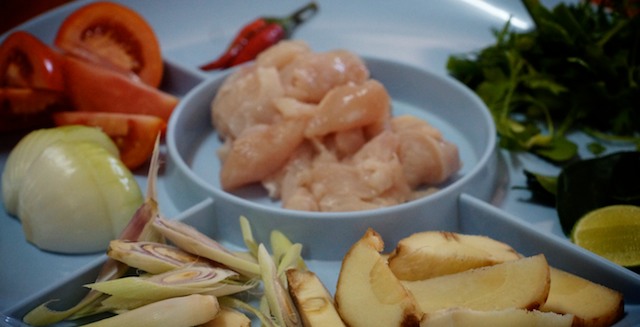
Ingredients for another favorite, Tom Kah Gai (Thai lemongrass/coconut soup)
My cooking station -- I was trying to film and photograph so I think my dishes suffered a bit of neglect. We enjoyed sampling each-other's dishes.  We each had to make some choices about how much of different ingredients to add even tho we were all making the 'same' entrees.  We made a menu of things not only that we liked but that we thought we could make back in Zambia:  green papaya salad, tom ka gai, steamed banana cakes, ginger chicken, and something we are all forgetting right now.  We need to check the video clips to refresh our memory!
mashing bananas for our little, steamed cake packets
They could tell mine by the diagonal skewer.  I did not follow directions, apparently.

Taking a deserved break.  Cooking is hard work.

Wat Rong Khun, the monkless White Temple


Construction on Thai artist/architect Chalermchai Khositpipat's life-long project, Wat Ron Khun, the White Temple, outside the city of Chiang Rai in Northern Thailand started in 1997 and is slated to continue for three generations.  As explained by our host, Chef Suwanee, the temple not only provides commentary about Thai culture, Buddhism and the artist's personal artistic vision, it also provides jobs and training for thousands in the area, in the arts, in the tourism sector, in the trades.  It is not only a temple to Buddhism but a legacy for the community.


While most temples are gold and gilt and red and green and blue and every color of the rainbow, the White Temple is....uh, white. It's decorated with glass and mirrors, silver and tin.  Khoitpipat feels that gold is representative of greed, corruption and temptation while white represents purity and truth. The only gold structure on the 5 acre site is building housing the toilets.  Also unique to Wat Rong Khun is that it is maintained by staff and volunteers and not by monks.


A turret from the golden restroom building next alongside one of the many umbrella/tree turrets.

"I am determined to return my life to my country, my religion, and all people around the world.  It was my strong intention to build a temple in imitation of heaven. I wanted it to be a heaven on earth.  I built a main building in the Buddhist monastery. I wanted it to be like a house of the Buddha with white color representing His purity and white glass representing His wisdom shining all over the earth and the universe." Chamlermchai Khosipipat


Posing with the artist...rather, posing with a plastic cut-out of the artist.  He was in Bangkok the day we were there. We're wearing matching Lanna-fisherman pants.  We are so cool.


ever-ongoing construction.  all part of his plan.

It's quite impossible to capture the scale of the project -- the sheer size of the temples and grounds as well as the enormous attention to detail. It's massive and yet every last tiny little thing is clean, decorated, painted, and adorned.


There is no admission fee.  Visitors can make small donations to the project (nor more than 10,000 Bhat $330 and there are no plaques acknowledging any donations anywhere as is common practice), and purchase artwork -- on the grounds is also a huge exhibition of his 'Masterworks' collection of paintings and sculptures.  Visitors can also contribute in another way that we found really touching, by buying a silver ornament (for 30 Bhat, $1, which I doubt even covers the cost); you add to the others.  When I say others, I mean the hundreds of thousands of others.  If you look up at the covered walkways you'll see them hanging overhead.  See?  There are a few. 


O, taking a moment to write and hang a message


The wat grounds has the 9 traditional temple structures but it also has man contemporary art pieces incorporated into the traditional design.  As you approach the main temple, for example, you must first pass thru a piece called 'Hell.' (To get to heaven you have to go thru Hell) The path is flanked by two seas of hands -- grotesque outstretched arms making desperate gestures and clawing their way to the surface. I noticed this quiet, pleading pair.


Before you set foot on the serpent fenced bridge over the ponds that surround the main temple you pass by two 2.5 m tall guards. Just a wee-bit intimidating.  Also intimidating are the temples' staff urging you via a public address megaphone to "Move along!" "ONE WAY!' "KEEP MOVING!" It wasn't busy so we did not get much scolding as I dallied with my camera waiting for the rest of the fam to catch up.


Inside the temple, traditional rules of etiquette are observed:  no photography, (bare) feet tucked under (mermaid style) if you sit, revered silence out of respect to those worshipping, covered shoulders and legs.  The temple interior is full of scaffolding and you can watch a team of artists at work on traditional murals and....very untraditional murals.  This is one of the things the White Temple is famous for -- the juxtaposition of images of Buddah, his story, paintings of Thai life and culture and also....George W. Bush riding a missle, Osama Bin Ladden's face peering out of a giant skeleton's eye socket. Superman.  Many Star Wars characters doing battle, etc.  All apparently a commentary on human fascination with good vs. evil and the fact that ancient religions and modern life are one, part and parcel.

There were two fans running in the temple and sitting in front of the fans were Thai worshippers....enjoying the gentle breeze and texting on their smartphones.

Saturday, July 27, 2013

Paparazzi


Perhaps related the the previously mentioned 'snapshot' informal survey of the tourism sector was the way that the boys were treated, Thing 2 especially.  Blond haired blue eyed little boys are virtually nonexistent everywhere we went.  And so, PFPJ was treated like royalty.

It was a bit disorienting to be in a country where people (apprently) don't mind being randomly photographed.  This is definitely not the case in Zambia and so I'm way out of the habit of taking peoples' portraits without their explicit permission and I'm really unaccustomed to being ASKED to take someone's picture!


(Above) I was actually wanting to take a picture of the psychedelic orange and yellow fuel and mixing contraption at the gas station (that was for the motorbikes?) but the attendant kept sneaking into the frame so I could take her picture.  Granted, clearly we were foreign tourists and traveling some kind of tourism circuit, so the expectation was there that we wanted to take photos was already there.  Still, I'm not sure what behavior was expected.  There were many photos that we wanted to take (the young monks goofing around and working at a temple construction side, launching loads of scrap timbers+bamboo over a cliff...)

There are rules about photography in Thailand that had be on edge.  For example, you can't take photos of Buddha.  At the airport and driving from the airport there are huge signs and billboards warning (in English) that you should not take photos, you should not buy trinkets of Buddha or buy statues to use to decorate your house ("Buddha is not furniture" proclaims one and shows pictures of Buddha heads for sale at a market and another shows how a ginormous Buddha statue is used to as decor at a hipster nightclub.)  But when you go to the temple of the famous reclining Buddha (Wat Pho) in Bangkok, that is what everyone is doing.  They sell tickets so you can go in and take photos of this statue.  Odd, right?


The reclining Buddha.  It's big and it's housed in a tiny little temple so it's actually quite impossible to get a photo of it. So TJ took pictures of people taking pictures.

The giant reclining Buddha's toes.  The feet are 3 m (12 feet) high and 4.5 (13.5 feet) long. The original Big Foot?

Another tourist trying to find a detail to focus on b/c you truly can't capture the massiveness of this statue.
Mother of pearl inlay detail on the Reclining Buddha's feet. In addition to this rosette on the soles of his feet there are 108 'panels' showing the auspicious characteristics of the Buddha.


(Above) Testing lenses at the Sony store.  The salesman kept insisting on being photographed.  (This is my new 50mm/1.8.  Why have I never owned this lens?? So fun)

This monk's interpreter/handler basically forced O to take this photo.  O studied Buddhism all thru Year  6 and was surprised to see that a monk was walking around this temple (as a tourist himself, b/c this particular temple does not have monks, that's another blog post) with an iPad when he learned that a monk can't even handle money much less have possessions like the latest iPad, so he asked.  Basically, if a monk is given something he can have it.  This isn't quite true, a monk can't accept anything ridiculous or lavish or something considered a luxury but the "rules" are a bit flexible and up for interpretation.  Things are not so clear cut.  


Journey to the year 2556


For many reasons we decided to forgo our annual pilgrimage to the mother land.  How fun to think that instead we engaged in time travel (to the year 2556) for our summer vacation, but we did!  How did we manage? Easy. We went to Thailand.

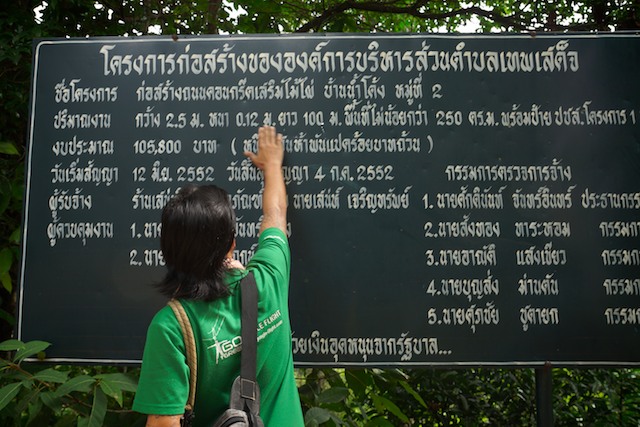
This photo was taken in the national park outside of Chiang Mai where we had an incredible adventure.  Our guide was answering the question "What does this sign say?" It's along the road to little village where a ziplining/adventure park company is based.  The company supports the village thru employment and they live a relatively 'traditional' lifestyle while benefitting from this small and relatively low impact tourism operation.  As far as the sign, it is basically just about the road, how it was funded, when it was started, when it was completed, how it is maintained.  Boring stuff, but this is when we said, "Uh, what do you mean it was started in the year 2552?"

Thailand (along with Cambodia, Laos, Burma and Sri Lanka) uses a Buddhist calendar as opposed to (or in addition to) the Gregorian calendar.  The simplified explanation is that the Thai Buddist year 0 is counted from the year Buddha attained complete nirvana, post 'awakening' (bodhi) and upon the death of his physical body.  In Thailand this was in March 545 BCE but for some reason was fixed at 543. The new year is April.  The calendar also factoring in the lunar cycle (counting the days of the month in two halves: waxing and waning) and the signs of the zodiac so the days don't match up always with the Gregorian calendar.  If we lived there we'd hopefully learn more about this.

We really missed out on a lot by not being able to read and not having someone to translate the many signs and brochures that were printed only in Thai script.  We left so many sites with unanswered questions and I'm sure missed out on so many things simply because we were basically illiterate there except when there was english script.  Where we were traveling and the kind of travel we were doing (not Euro/American backpacker tourism) the guides all said that their clients were 75% chinese 15% Thai and the rest Japanese, European with a few Americans.  Interesting.

One bit of script worth learning: